
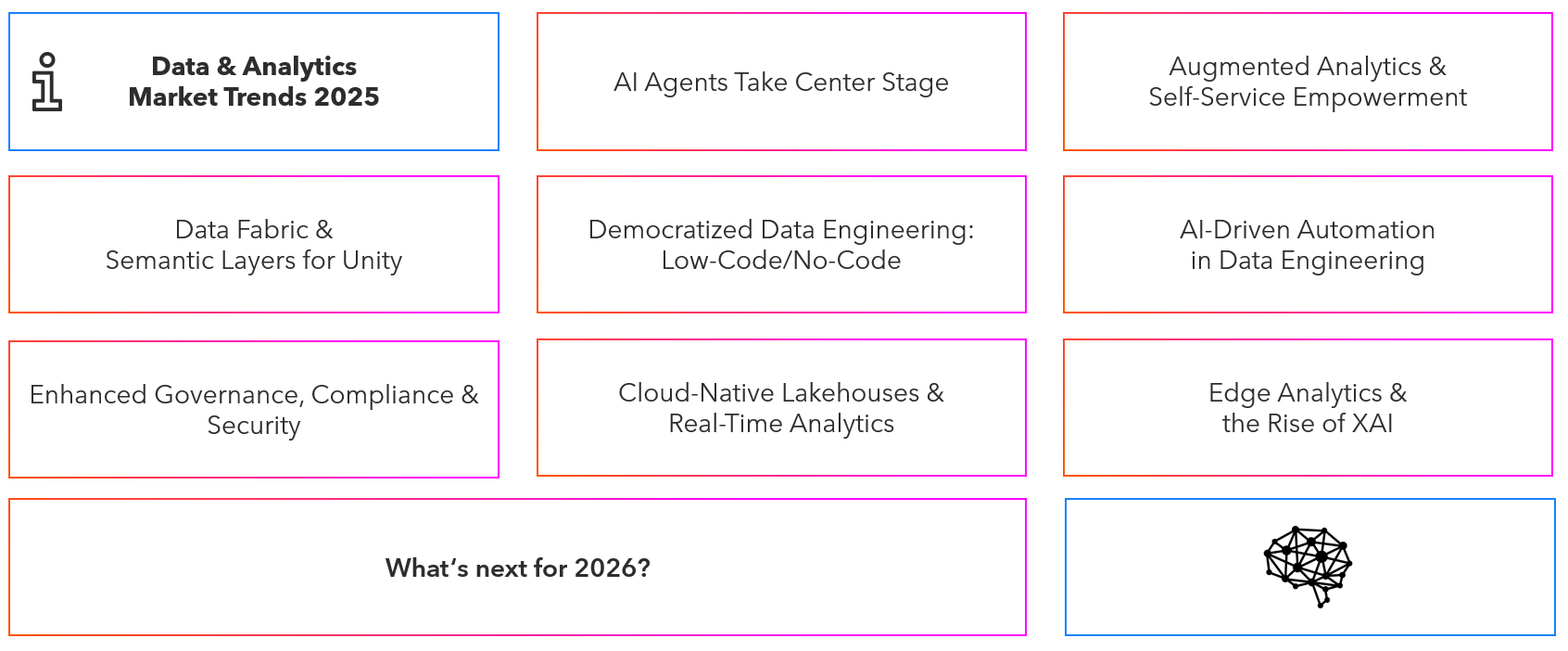
Data & Analytics Market Trends 2025
Can you confirm? Whats next for 2026?

In 2025, the Data & Analytics market is witnessing transformative innovation across multiple fronts. Several key trends are shaping the future of how organizations harness data:
AI Agents Take Center Stage
AI agents are rapidly becoming a staple in modern data platforms. Cloud providers like Google Cloud offer agents that automate tasks across pipelines, legacy migrations, exploratory analytics, and business-user queries.
The shift toward AI agents is imminent - with Gartner forecasting that by 2028, 15% of everyday decisions will be made autonomously by agentic AI, up from zero in 2024.
Reflecting this, practitioners on Reddit note the rise of “agentic data” - systems that autonomously manage and optimize data in real time.
Augmented Analytics & Self-Service Empowerment
Augmented analytics - the blending of AI with human decision-making - is becoming ubiquitous. Gartner expects 75% of enterprises to have adopted these tools by 2025.
Self-service BI, enhanced with natural language interaction, enables non-technical users to explore data intuitively - some tools now deliver experiences as user-friendly as social media apps.
Data Fabric & Semantic Layers for Unity
Data Fabric architectures are forging unified access to scattered data, enabling real-time analytics and metadata-driven automation. IDC predicts that by 2026, 60% of enterprises will have adopted data fabric.
Complementary semantic layers ensure consistency, security, and compliance across diverse environments.
Democratized Data Engineering: Low-Code/No-Code
No-code and low-code platforms are fundamentally changing how data pipelines are built. These tools accelerate ETL design via drag-and-drop interfaces and natural-language prompting - democratizing data preparation beyond specialized engineering teams.
However, community feedback reveals limitations in complex scenarios, with some users reporting frustrations with scalability and flexibility.
AI-Driven Automation in Data Engineering
Automation pervades data operations: AI now assists with schema detection, pipeline tuning, root cause analysis, and quality assurance.
Predictive data quality systems proactively flag anomalies and schema drift, helping preempt data issues.
Enhanced Governance, Compliance & Security
AI is increasingly used in managing access controls dynamically, reducing manual governance burdens.
Survey data shows a significant increase in robust governance frameworks: up from 42% in 2023 to 78% by 2025.
Despite this progress, concerns persist - especially over third-party visibility and AI-related risk exposure.
Cloud-Native Lakehouses & Real-Time Analytics
Lakehouse platforms such as Databricks and Snowflake now merge the architecture of data lakes and warehouses, enabling scalable, real-time querying.
Real-time processing becomes mission-critical across industries, supporting ripple-free fraud detection and customer insights.
Edge Analytics & the Rise of XAI
Edge analytics is emerging as a major domain, with estimates that 75% of enterprise data will be processed at the edge by 2025.
Explainable AI (XAI) is gaining traction - demand is rising for transparency and fairness in AI systems.
Conclusion
The Data & Analytics landscape in 2025 is defined by autonomous intelligence, democratization, securitized governance, and holistic platforms. Organizations now expect data infrastructure that integrates analytics, AI, self-service, and compliance into one seamless experience. As they tow away from fragmented tool stacks, the future favors platforms equipped with agentic capabilities, real-time responsiveness, and user-centric design.
Thank you for sharing these great insights. The shift toward AI agents, data fabrics, and metadata driven automation is clearly accelerating.
It's really aligned with what we’re seeing in the field. Open source initiatives like Apache Gravitino (https://github.com/apache/gravitino) are part of this evolution, helping organizations build unified, intelligent and AI ready data foundations.