
Gartner Data & Analytics Summit 2026 - Insights
What one of the most influential events in the field reveals about the current state of data and AI.

The Gartner Data & Analytics Summit 2026 centered on the transition from experimental Artificial Intelligence (AI) to the establishment of AI-native organizations. The event introduced a framework for value realization termed the Return on Intelligence (ROI), which comprises three pillars: setting organizational ambitions, strengthening technical foundations (Return on Integrity), and empowering the workforce (Return on Individuals).
Context and Semantic Layers
Architecture for AI-native operations requires an integrated context layer, described as the conceptual “brain” that enables autonomous agents to make trusted decisions. This layer connects disparate information sources to provide a comprehensive view for both human users and digital agents.
Foundation Investment: Organizations reporting high satisfaction with AI initiatives allocate more funding to foundations—specifically data quality, governance, and talent—than to AI tools. In these organizations, foundations account for the majority of total AI spending.
Semantic Foundations: The semantic layer provides single, consistent definitions for business terms, such as “revenue” or “active customer”. This consistency is required to prevent AI hallucinations and ensures that both human analysts and agents operate from a unified logic.
Technical Integration: While the Model Context Protocol (MCP) is used as an interface for agents, it requires support from ontologies, knowledge graphs, and governed semantic layers to facilitate complex, multi-step analytics.
Data Readiness: Data management is shifting to include multistructured and unstructured data, requiring workflows that orchestrate entity extraction, vector embeddings, and semantic enrichment. Data twins—smaller, representative subsets of total data populations—are being utilized as data products to accelerate exploration and hypothesis testing.
Organizational Transformation
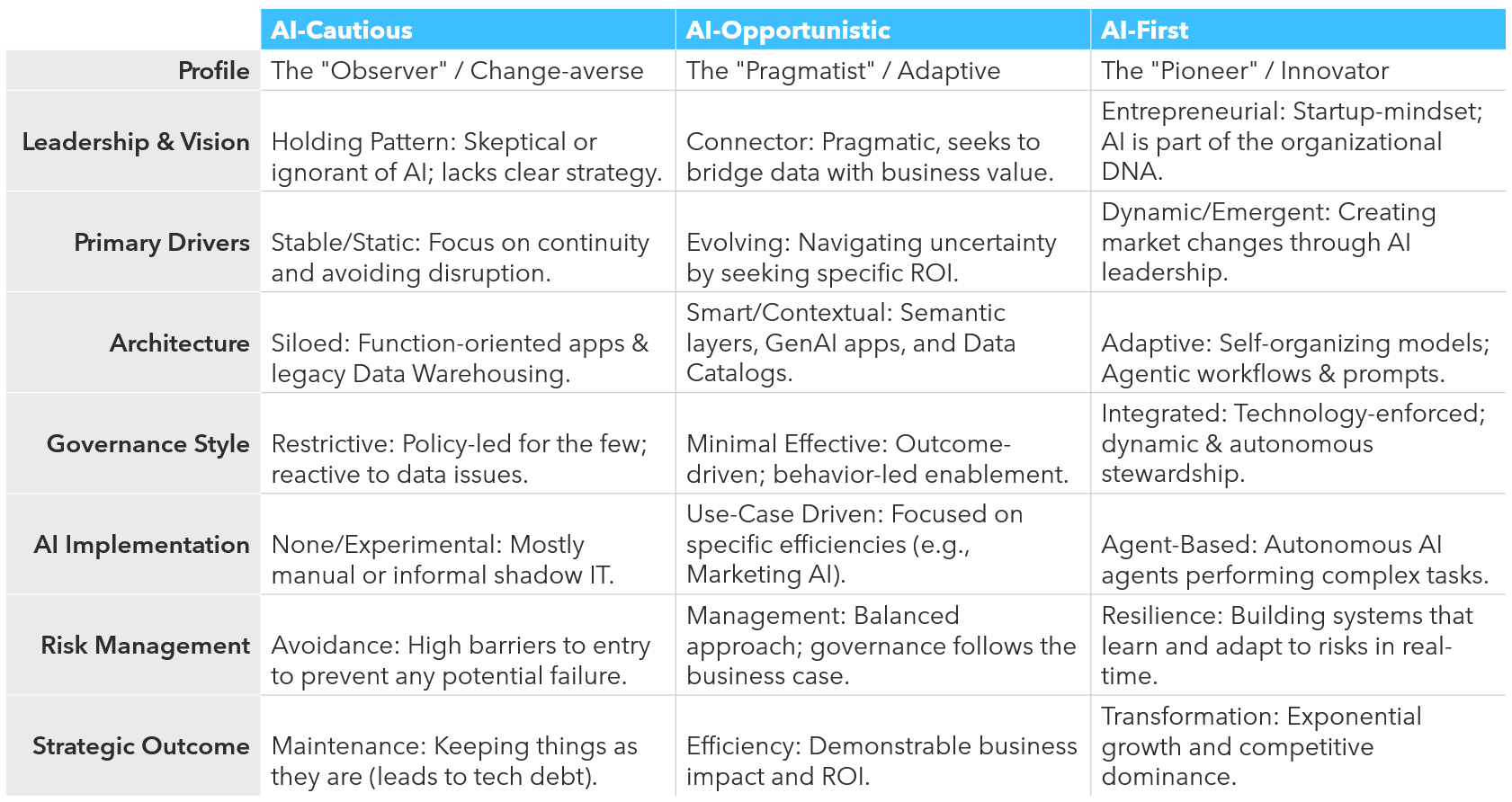
Enterprises are categorized into three archetypes based on their AI strategy: AI-Cautious (focusing on guardrails), AI-Opportunistic (focusing on incremental pilots), and AI-First (integrating AI into strategy and culture).
Leadership Roles: High-maturity organizations have increasingly established the role of Chief AI Officer (CAIO), or a dedicated AI leader, often reporting directly to the CEO.
Skills-Based Planning: Organizations are moving away from rigid role definitions toward identifying specific skills and proficiency levels required for high-priority initiatives.
Fusion Teams: The workforce structure is evolving into human-AI fusion teams. In this model, human professionals and AI agents collaborate in hybrid settings to handle analysis, automation, and operational tasks.
Agility and Consistency: Optimal organizational models for data and analytics balance centralized enterprisewide enablement with decentralized, outcome-focused needs.
Data Governance
Data governance is evolving from a centralized, manual function to an essential enabler for scaling AI safely. A lack of governance maturity is identified as a primary reason for the failure of AI initiatives.
Adaptive Frameworks: Governance models are transitioning from simple distributed controls to adaptive frameworks. These frameworks utilize technology-enforced behavioral controls and business-outcome-driven models.
Decision Governance: The focus of governance is expanding from “trusted data” to “trusted decisions“. This involves determining the appropriate use cases for AI and establishing accountability for outcomes.
Integration with Business Workstreams: Governance is being redefined as a “team sport” that must be embedded directly into normal business operations and culture rather than functioning as an isolated IT task.
Automated Compliance: Future governance models emphasize machine-verifiable data contracts and automated policy enforcement to manage increasingly complex and distributed data environments.
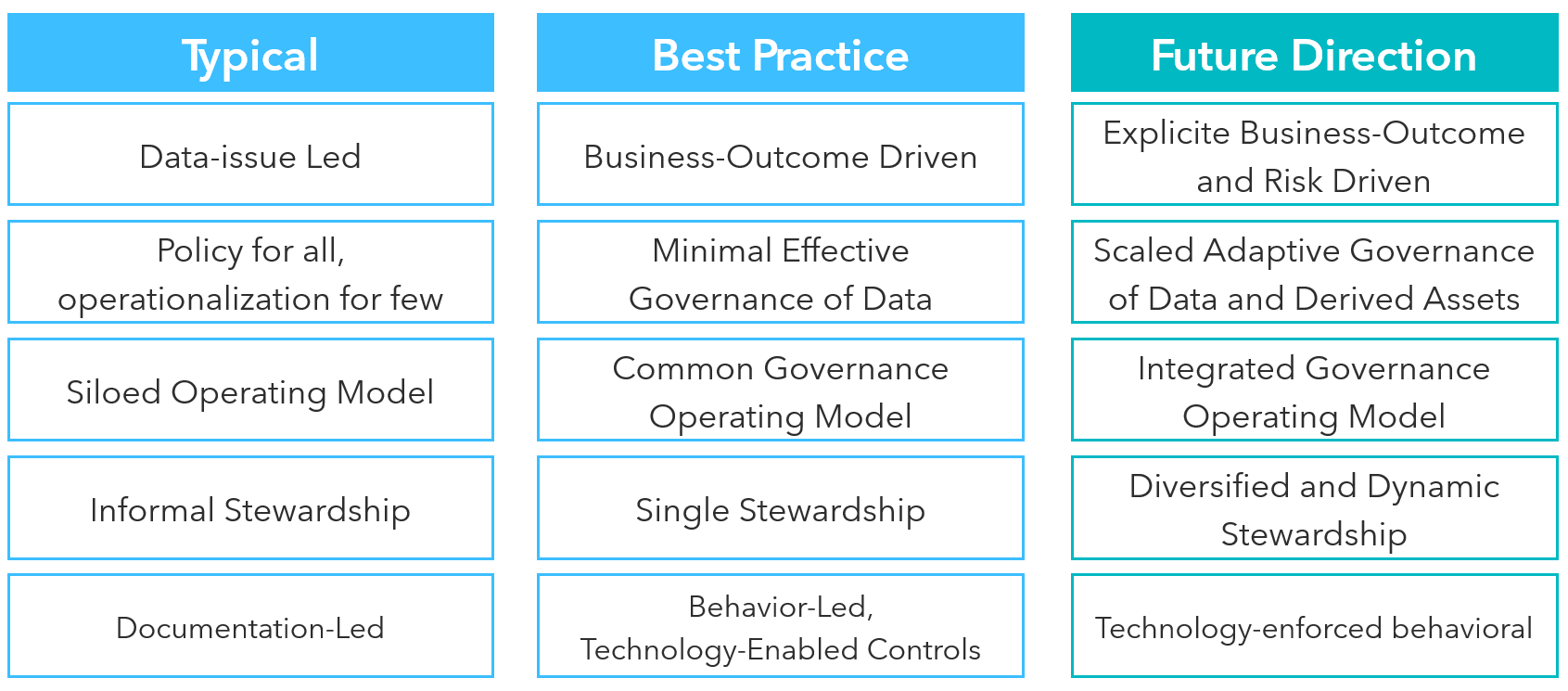
“Typical” - The Reactive & Siloed Approach
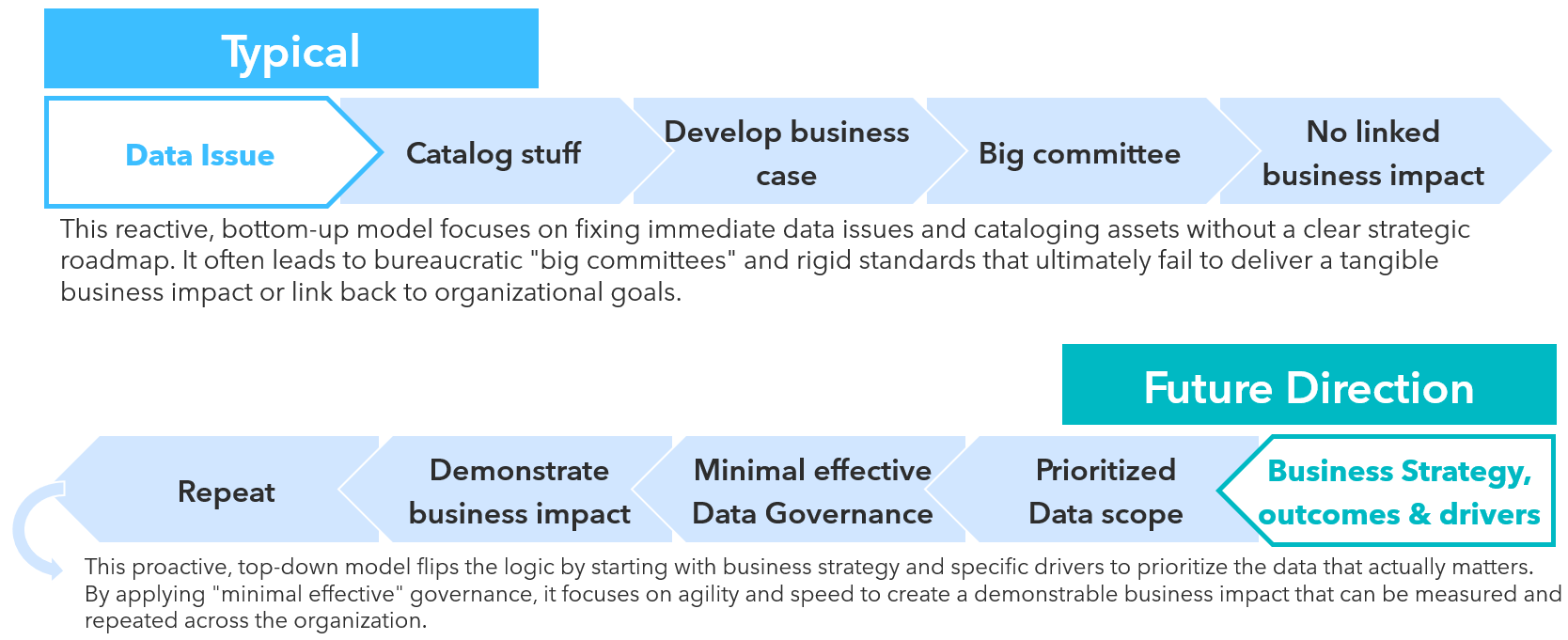
In this stage, Data Governance is largely reactive. It is triggered by specific data quality issues or compliance requirements rather than strategic goals. Because policies are often “one-size-fits-all” and documentation-heavy, they are difficult to implement across the entire organization. This results in fragmented “silos” where different departments manage data inconsistently, relying on informal responsibilities that lack accountability.
“Best Practice” - The Outcome-Oriented Approach
Organizations at this stage shift from “policing” data to enabling the business. Governance is designed to be “Minimal Effective,” meaning it provides just enough control to achieve specific business outcomes without creating unnecessary bureaucracy. By establishing a common operating model and clear, single points of stewardship, the organization ensures consistency. Technology is used to enable better behavior rather than just recording it.
“Future Direction” - The Adaptive & Automated Approach
The future of Data Governance is proactive, risk-aware, and highly automated. It is no longer a separate activity but is “integrated” into every business process. This “Adaptive Governance” style scales across not just raw data, but also AI models and derived assets. Stewardship becomes dynamic—changing based on the context and importance of the data. Most importantly, technology moves from simply enabling behavior to enforcing it, making compliance and high data quality an architectural certainty rather than a manual task.
For more insights see: