
Technical Implementation in Data Management is Dying Out
A personal story

Just realized that I once reduced my working time by 80% through optimizing my analytics workflow and automating the data acquisition process - in my first job in 2001.
Been in logistics we regularly extract data from SAP, dumped and tried to analyze it in MS Excel, e. g. for slow-moving item analysis. I came into the job as it was to much work for only one person.
After some weeks I
learned how to create views and queries to connect data in SAP
learned how to schedule a report for data extraction over night
built a MS Access database to consolidate and handle larger and historical amounts of data
used Excel formulas and pivot for faster analysis of warehouse data
It was kind of revolution. Than after 6 months I quit my job to study business informatics. The rest is history 😉
Today people use Power BI and Copilot (or anything else, you name it) to still do similar things 25 years later. More data (through digitization), more cases (through better understanding what is possible), in shorter time (as always).
While studying I learned about databases and OLAP functions. After doing my thesis in Data Mining (pretty much Machine Learning, but essentially using everything what works to get results from data), I started as a BI consultant in 2006.
At this time BI meant doing data modeling / data warehousing, doing ETL including coding, system analysis in the source, building reports, using planning functions, create complex analysis processes and even doing data mining. End-to-End, often from one consultant. I never thought of topics not relevant, because everything what helps to reach the result was good.
Being in consulting and companies for 20 years now, I read this today:
Technical implementation in data management is dying out. Service providers who still sell “person days” today and fail to transform themselves into “knowledge workers” and strategic transformation partners will be made redundant by their customers’ AI.
In the age of AI, pure “technical know-how” is a commodity. In the future, the true value for service providers will lie exclusively in their shared responsibility for context, change competence, and the sustainable establishment of responsible AI governance. This must be reflected in value-based pricing.
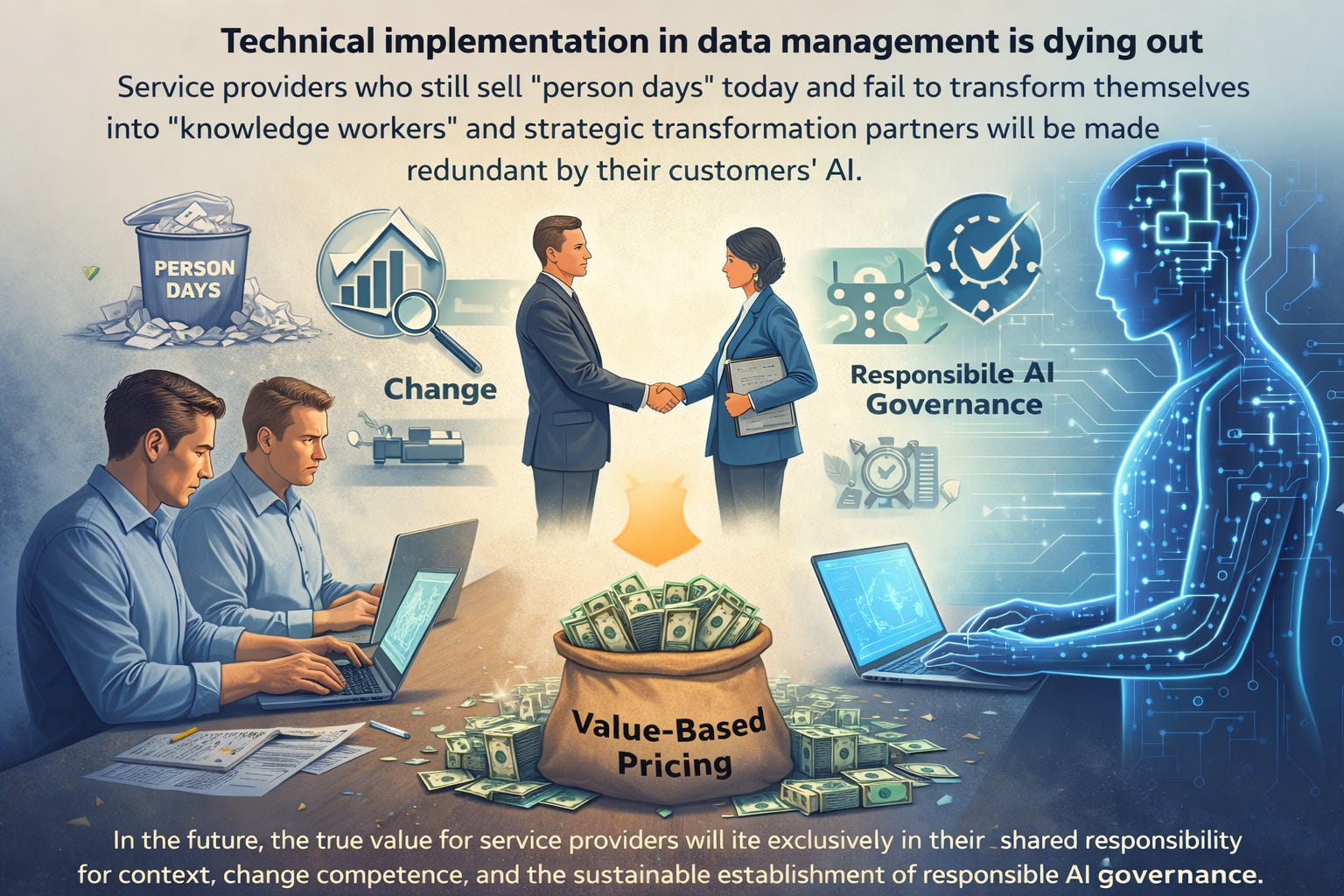
As I’m in strategy consulting for Data, Analytics and AI, I could say, “thank god, I’m already where others should go to”, in the next (as I discussed today with a colleague) 2-3 years.
We (my employer, I) are massively knowledge workers, doing strategic transformation with our customers, helping them build and establish AI applications and AI governance. Great! And it aligns pretty much with my thoughts in my article “AI Disruption & Augmented Consulting”.
When I did the step from implementation to strategy it was because I have seen that implementation without goals and direction is like driving a car without knowing the route and destination. It feels like being productive but it isn’t a real value. In every role it is right to bring together the right understanding of helping the customer/partner/consumer (internal or external) to succeed and support change and going forward against a common goal. No need to have the word “strategy” in your title. If you havn’t done that until now, it is in every case something to be adjusted.
Always if I read or hear such bold statements as above, I think about how everything started (at least for me) and we always thought about how things will change in the next years, how fast technology evolve, how strong automation is. Being 20 years in Data & AI, I have only seen growth and I’m sure I will see further growth. Not because AI will change to a state replacing todays work and technical know-how. Rather because AI is not here for replacing but for changing things which creates new roles, new work and new competiencies as it always did.
If AI helps us become what we should always have been, then let it happen.
I know there are jobs you learn less and less every year you are in. Being in Data, Analytics and AI is the direct opposite from my experience. It’s all about learning and adapting. Or as we hear it often currently: Learn, unlearn and relearn.
If you want, tell me what you think about the current impact of AI, how your history changed and what working in Data, Analytics and I should really be and help for.
This is real, and while LLMs are getting better at using SQL and ETL tools like db, they are already really good at using semantic layers like looker and cube to do all this data modeling. The same applies for infra, as long as it can be expressed as a code it can be automated. So the real work transforms into automation of all these tasks. We should really focus on mastering this techniques and choosing tools that are code first .