
The AI Job Apocalypse
What is important to understand about the future of our jobs

Even with all the data and technological progress, we have no crystal ball what will happen with AI and how this will impact our jobs and society in the next years.
I did an analysis, based on discussions, research and market developments. This is for sure biased, but also a wrap up of the current discussion.
Some thoughts and assumptions:
✴️ AI will replace a significant number of jobs across many sectors (especially white-collar work).
✴️ AI capability growth is currently not the limiting factor - Organizational readiness, resources, economics, and social adaptation determine the pace and depth of job replacement.
✴️ AI strongly pushes toward job substitution, but structural counterforces convert this pressure into a slower, selective, and uneven transformation.
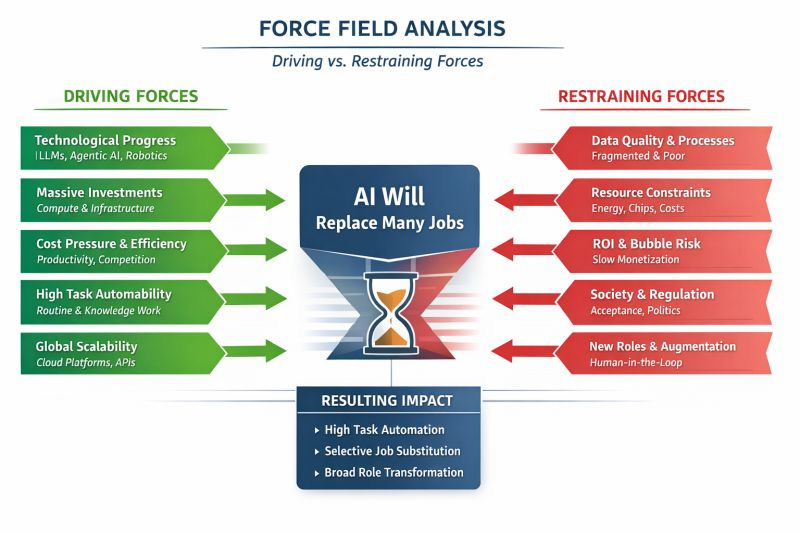
Fig.: Forces influencing AI’s effect on our jobs
There are already some occasionally discussed effects we should consider:
Jevons Paradox: As AI makes task completion more efficient and cheaper, the overall demand for those tasks increases rather than decreases.
Example: Making coding faster with AI assistants has led companies to launch more ambitious software projects rather than hiring fewer developers.
Polanyi’s Paradox: Human skills based on intuition, context, and “knowing more than we can tell” remain difficult to automate because they cannot be fully translated into data.
Example: While an AI can draft a legal contract, it cannot replicate a lawyer’s intuitive ability to read a judge’s subtle emotional cues during a high-stakes negotiation.
Moravec’s Paradox: High-level reasoning requires very little computation for AI, whereas low-level sensory-motor skills - like walking or folding laundry - require enormous computational resources.
Example: It is currently much easier to build an AI that passes the bar exam than to build a robot that can reliably clean a cluttered hotel room.
Lump of Labor Fallacy: The mistaken belief that there is a fixed amount of work to be done, leading to the fear that if AI does one task, there is no work left for humans.
Example: Even as AI automates data entry, it creates new demands for data ethicists and AI trainers, proving that the total “pile” of work is constantly expanding.
Complementary Talents: Technology diminishes the value of routine skills while exponentially increasing the value of human skills that “pair” well with the new tools.
Example: As AI generates thousands of images instantly, the human skill of “creative direction” and “curation” becomes significantly more valuable than the technical ability to use a paintbrush.
Amara’s Law: We tend to overestimate the short-term impact of AI (leading to hype or panic) while deeply underestimating its transformative long-term effects.
Example: People are currently disappointed that AI hasn’t “replaced” every office job this year, while ignoring how it is fundamentally rewriting the DNA of scientific research for the next decade.
If AI can do your job better, faster and cheaper than you, let it and be happy. To fight it makes no sense. We often discuss about our “value” or right to be here, but we shouldn’t. We are humans - machines (AI) are here to work for us. Focus on living, not comparing. Find your purpose.
To simple? Maybe. I neclect that our society is not ready for that. But if it is somehow possible to think about personal development instead of being replaced, your go into the right direction.