
The Data Profession
If Data is not just your Job but your passion

From “Knowing” to “Being”
In the iconic scene from the movie 300, King Leonidas asks a simple question to the Arcadians who have come to join his ranks: “What is your profession?” While the Arcadians outnumber the Spartans, they are potters and blacksmiths. Leonidas points to his 300 and identifies them as what they truly are: warriors by trade.
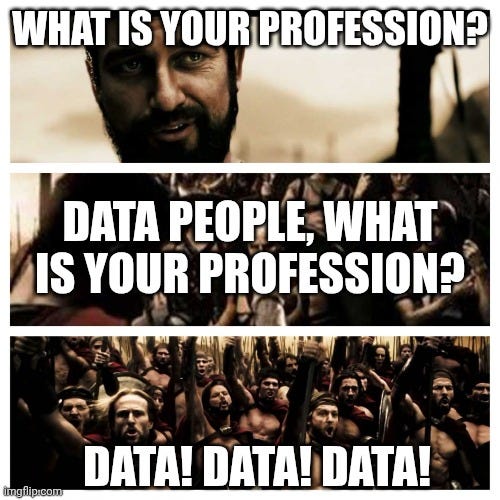
In the world of Data & Analytics, Strategy Consultants often find themselves in this “Spartan” role. They dive deep into the “Pass of Thermopylae”—the actual pain points of the business departments—only to return with a strategy that is met with a familiar phrase from leadership: “We already knew that.”
However, there is a crucial nuance to this analogy: Unlike the Spartans, the consultant eventually leaves the battlefield.
The Consultant’s Paradox
In Agile circles, there is a famous fable about a pig and a chicken opening a restaurant. The chicken suggests “Ham and Eggs.” The pig declines, noting: “I would be committed (the meat), but you would only be involved (the eggs).”
The Strategy Consultant is the “Chicken.” They provide the expertise, the eggs, and the recipe. But the internal leadership—the CIO, the Head of Data—is the “Pig.” They are the ones who stay. They provide the “meat” (the resources, the long-term career risk, and the persistence).
This creates a tension: The leader feels the weight of long-term accountability, which often leads to the defensive “We already knew that” as a way to maintain authority. The consultant, meanwhile, feels the frustration of seeing a “Spartan” plan fail due to “Arcadian” execution.
Bridging the Gap
To ensure a strategy succeeds once the consultant has left, we must move from mere involvement to shared commitment.
1. Establish Single Points of Accountability (SPA)
Because the consultant will leave, the “Pig” (the internal owner) must be identified early. Every core initiative must be owned by a leader from the business side. When the Head of Sales is accountable for data quality, it becomes a commercial priority that survives the consultant’s departure.
2. Empower the “Data Translators”
The greatest friction exists in the zone between local business workarounds and central IT architecture. High-performing organizations invest in internal Translators—professionals who stay on the ground to ensure requirements are precise and actionable long after the strategy deck is closed.
3. The “Pilot-First” Governance
Execution requires momentum. By delivering a tangible win in one department within 90 days, the consultant provides the internal team with the “victory” they need to sustain belief in the strategy. It’s about building internal muscle memory.
4. Define “Done” through Resource Commitment
A strategy is not “accepted” when the final slide is shown; it is accepted when the internal budget and personnel are locked in. The consultant’s job is to ensure the “Pigs” have everything they need to be successful before the “Chicken” moves on to the next project.
5. Transition to a Living Backlog
Static reports die. Professional execution treats a strategy as a Living Backlog. By transforming recommendations into trackable “tickets” in the client’s own systems (Jira/Azure DevOps), the strategy becomes part of the daily grind rather than a distant memory of a consulting engagement.
Conclusion
The “Spartan” consultant brings the specialized skill of the warrior, but the “Arcadian” leader brings the world that the warrior is fighting for. Respecting that the internal leader carries the long-term risk is the first step toward a successful partnership.
True value is not created when a consultant proves they are right; it is created when the internal team is empowered to act as if the strategy were their own idea all along. After all, the best strategy is the one that is still being executed long after the strategist has gone.