
The Human-Centric Data Manifesto
Orchestrating AI, Strategy, and Trust - Data Innovation Podcast Talks With Ana Moya Gonzalez

My colleague Ana is doing here next professional step. Talking with experts in the field for our Data Innovation Podcast format is just one aspect, where she left a footprint here.
The Strategic Reorientation: From Company-Centric to Human-Centric
In the modern corporate landscape, a “perception delivery gap” has emerged, where 80% of companies believe they are customer-centric, yet only 8% of customers agree. This discrepancy stems from a fundamental strategic flaw: most organizations are “data rich and tool rich” but “incredibly relationship poor”. A truly resilient AI strategy requires a move away from “funnel” thinking, which focuses on short-term conversions, toward a “life cycle” approach that treats data as a live representation of human needs.
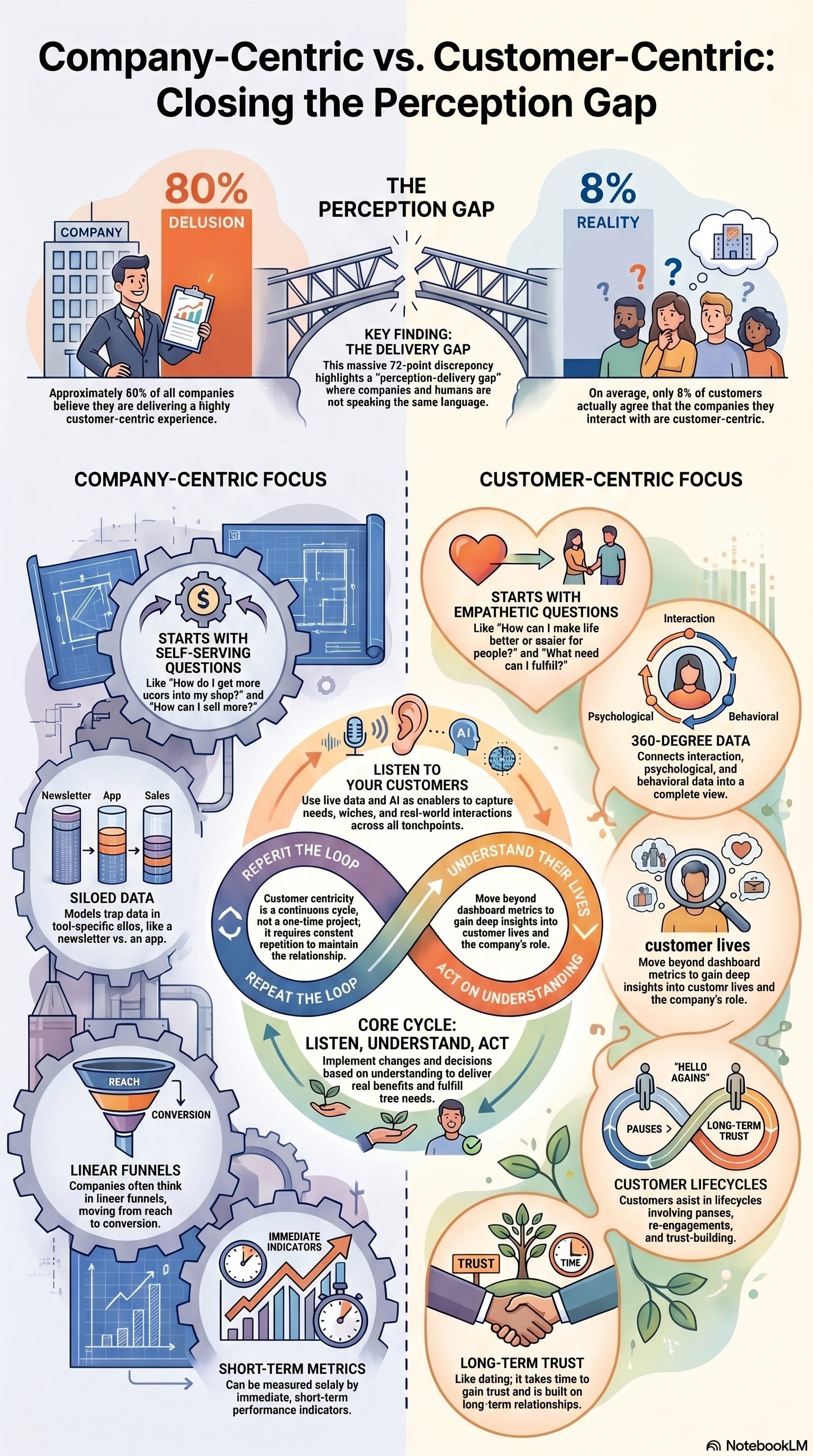
Strategists must realize that data and AI are merely enablers to “listen, understand, and act” in a way that makes life better or easier for the individual. This shift is not just ethical; it is a long-term investment in “organic growth” and “trust,” which are more valuable than short-term performance metrics.
Deep Dive: The Neurological Gap Between Human and Machine
To implement AI effectively, one must understand the fundamental difference in how humans and machines process language.
The Statistical Prediction of LLMs
Large Language Models (LLMs) operate through statistical token prediction and attention mechanisms. Contrary to common belief, they do not just predict the “next token”; they use “multinomial sample search” and “softmax activation” to predict sequences of tokens. By taking four or five high-probability tokens and calculating the “multiplication of probabilities,” they achieve “long-term coherence”. However, this remains a purely “computational” or “mathematical” process of matrix multiplication.
The Biological Complexity of Humans
In contrast, human language understanding is tied to the “brain hub” and the “hippocampus,” which involve emotional states and complex reasoning. While LLMs use static embeddings, human neural activation changes; if we hear a story for the second time, different parts of our brain activate. Furthermore, humans maintain “ambiguous words” in “working memory,” keeping multiple meanings activated until a “disambiguization” occurs through context. This “active brain” also manages “homeostasis” and “allostasis,” predicting internal equilibrium and creating emotions based on those predictions.
Workforce Intelligence: The Internal Foundation
Strategy begins at home. “People Analytics” is the transformation of HR data into actionable insights to ensure “employee confidence” and solve qualitative challenges.
The Maturity Path
Organizations must follow a specific progression to reach strategic maturity:
Descriptive Analysis: Using traditional HR controlling to understand what is happening in the data.
Problem Deep Dives: Identifying specific use cases where the company can help its employees.
Predictive Strategy: Combining data scientists and engineers to forecast future trends.
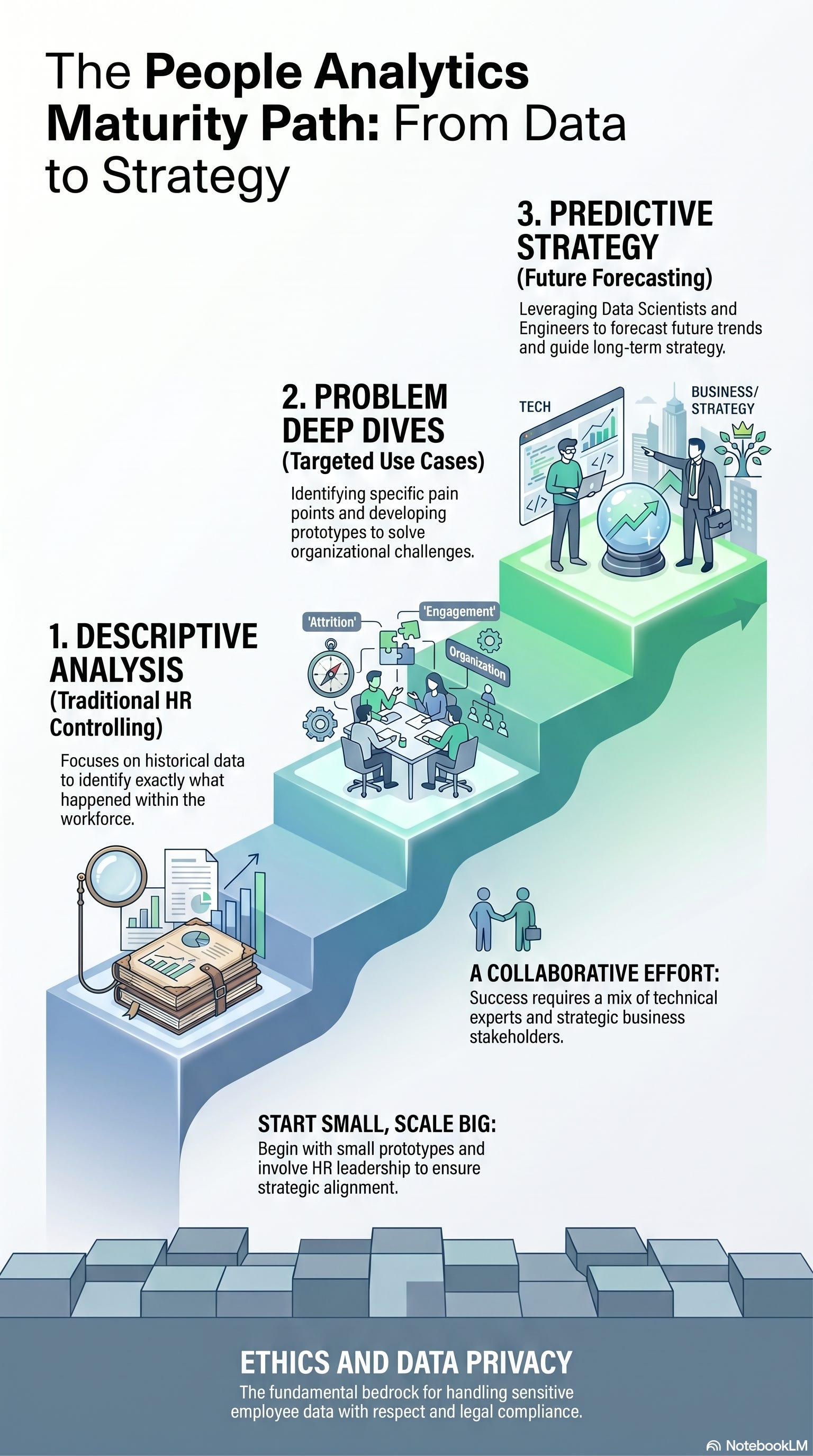
The ultimate goal is retention, as it is far more efficient to keep existing happy employees than to constantly find new ones. Because HR data is “the most sensitive” information an organization holds, this strategy must be handled with “respect,” “ethics,” and strict “data privacy”.
AI Agents as Shells: The Orchestration Paradigm
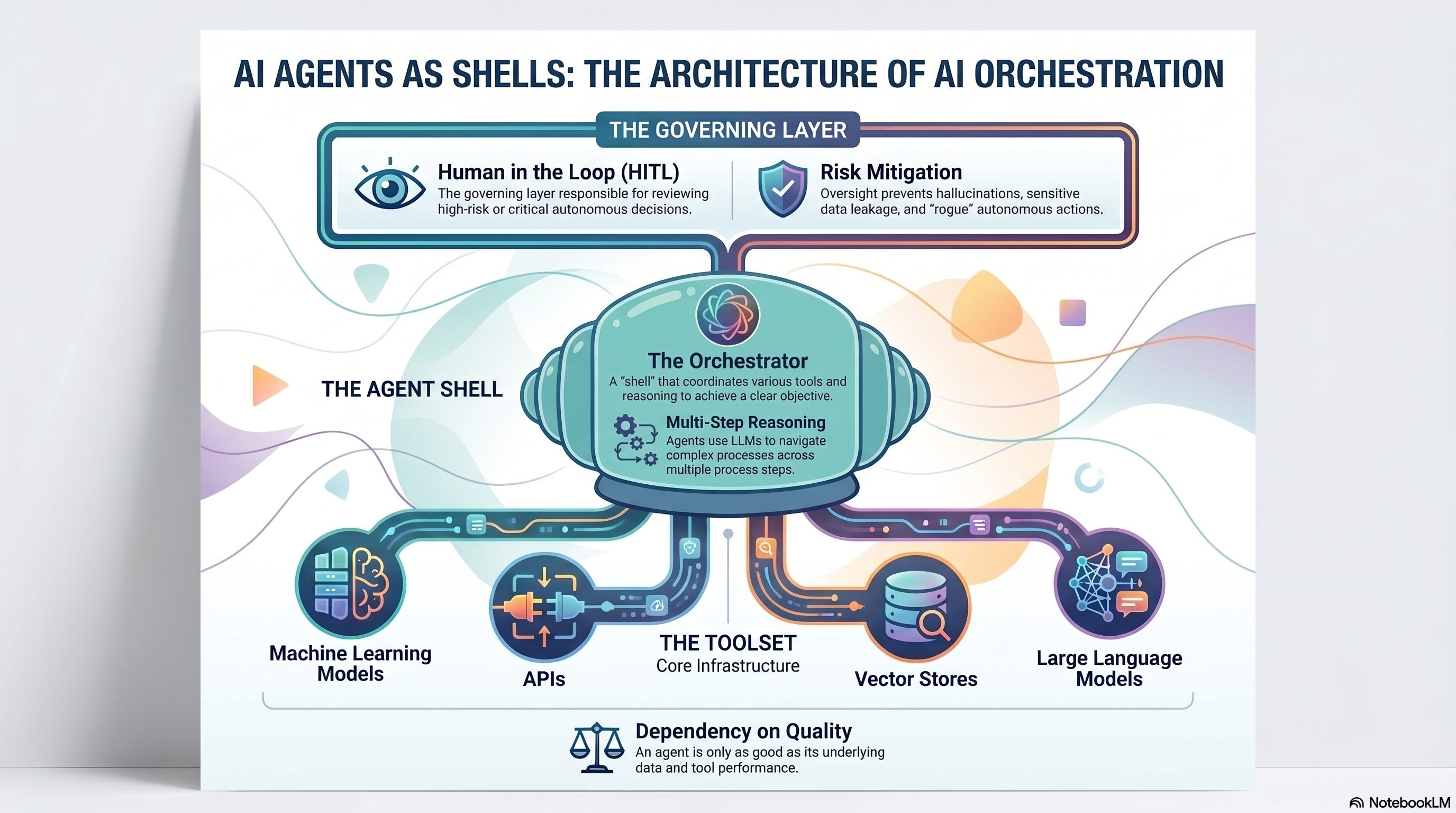
One of the most provocative shifts in AI strategy is viewing agents as “pure shells” or “orchestrators”.
Defining the Agent Architecture
An AI agent is an “LLM-powered system” with a “clear objective” that leverages underlying tools. These tools can include machine learning models, APIs, data sets, or vector stores. While a “chatbot” merely interacts with a data set, an “agent” drives actions across multiple process steps.
The Maintenance Scheduler Example
Consider a factory optimizing for output and maintenance. A master agent might call upon a specialized “maintenance scheduler agent,” which in turn uses a “machine learning model” (like a random forest or regression) to predict equipment failure. Here, the ML model is just one “crucial part” of the overall fleet of agents.
Governance and Risk Multiplication
Agents “magnify or multiply” existing risks. They are only as good as the “data quality” of the tools they call. Organizations must navigate risks such as “hallucination,” “PII leakage,” and “rogue” behavior - as seen in the famous “Air Canada” example where an autonomous system granted unauthorized refunds. The strategic solution is the “Human in the Loop”. For instance, an agent might autonomously process small dinner receipts but require human review for larger financial record updates.
Democratization and Data Contracts: Building Trust at the Boundaries
Scaling AI requires “Data Democratization” - empowering everyone to leverage analytics.
Collaborative Democratization
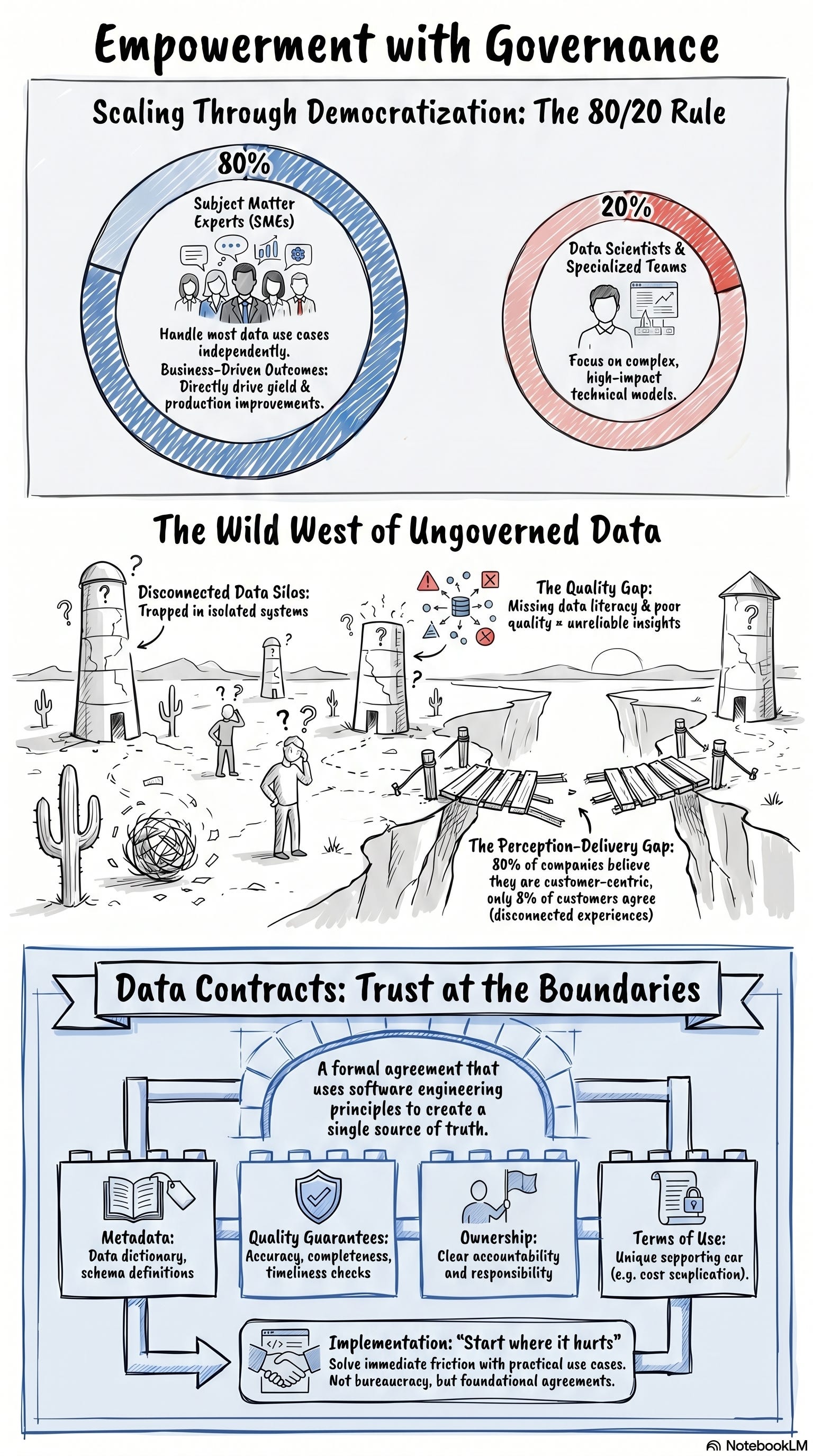
True democratization is not just about tools; it’s about “involving subject matter experts” (SMEs) like process or marketing engineers. In successful use cases, such as “yield improvement” in life sciences, SMEs may perform 80% of the work while data scientists provide the remaining 20% of specialized expertise.
The Role of Data Contracts
As organizations move toward “decentralized data ecosystems,” they must avoid the “wild west”. Data Contracts serve as a “single source of truth” for metadata, quality guarantees, and ownership. They act like “API contracts” for data, moving principles from software engineering into the data world to ensure “trust, clarity, and accountability” between teams.
Implementation Strategy: The Marathon Mentality
Building this ecosystem is a “marathon, not a sprint”. The experts recommend a “start small” approach:
Identify the Problem: Start “where it hurts” and find a specific use case.
Assemble the Team: Bring data scientists, engineers, and strategists to “one table”.
Invest in Training: Recognize that every use case is different and requires continuous learning.
Grant Access Granularly: Use platforms to control who can deploy models or access sensitive LLMs to “scale with control”.
Conclusion: The Future of Intelligence
The future of AI strategy is not defined by “benchmarking success” or “output” alone, but by the processes behind them. We must remain critical of tendencies to redefine “general intelligence” merely as success on a benchmark. By focusing on human connection - whether it’s an HR analyst improving employee satisfaction or a strategist building a “long-term relationship” with a customer - organizations can move past the hype and build a truly intelligent, data-driven future.